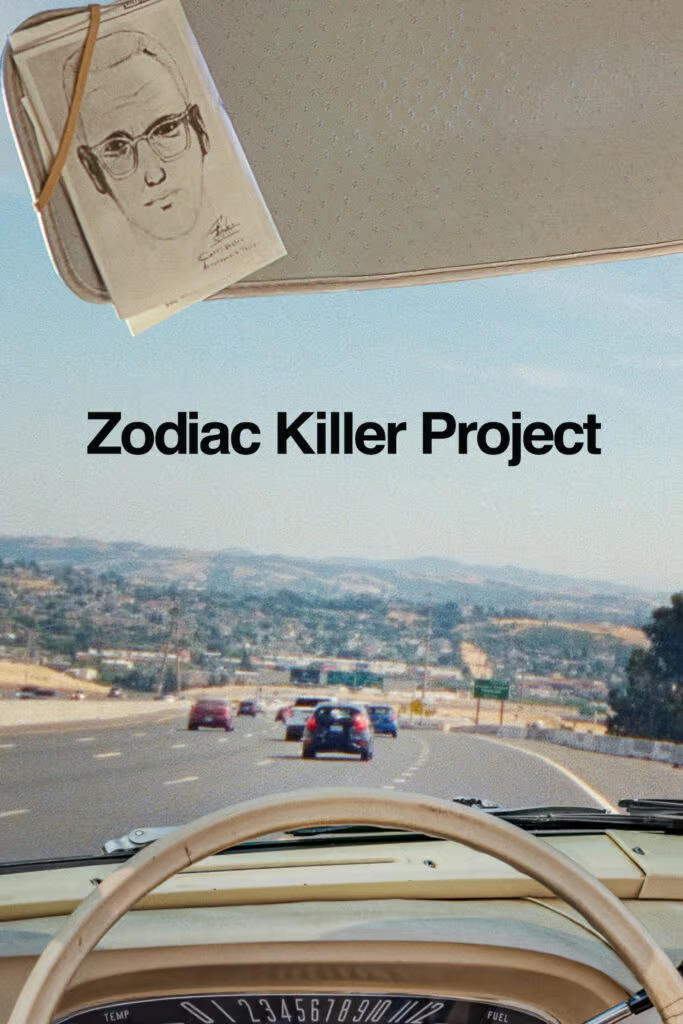
In 2020, the Chronicle described the Zodiac case as “the most famous unsolved murder case in American history”. It is easy to understand why the story still has such a grip on popular culture.

Design. Build. Launch. No Code Needed.
From portfolio websites to full webshops – Elementor lets you build custom WordPress sites visually, fast and beautifully. Join 14M+ users who choose freedom, flexibility, and full design control.
The killer’s identity remains unknown. His narcissistic games with the local media around Vallejo and San Francisco in 1968 and 1969 transformed a series of crimes into something larger: a mystery, a spectacle and, eventually, a cultural obsession.

True-crime audiences have been dining out on that cocktail ever since.
Add the language and structure of the television documentary—the ominous music, blurred photographs, floating evidence and unanswered questions—and the formula becomes almost impossible to resist.
We know the tricks. We still fall for them.

The Easiest Way to Stay GDPR-Compliant
The film that could not be made
The central idea behind British filmmaker Charlie Shackleton’s Zodiac Killer Project is brutally simple: the documentary he intended to make no longer exists.
Shackleton had been developing a conventional true-crime film based on a written account of the Zodiac case. Negotiations over the rights appeared to be moving forward. Then they abruptly collapsed.
The project died before production could properly begin.
For many filmmakers, that would have been the end of the story. Shackleton makes it the beginning.
Instead of hiding the abandoned film, he walks us through it. In voice-over, he describes the documentary he had planned to create: its scenes, transitions, archive footage, dramatic beats and carefully engineered revelations.
We are invited to imagine a film while watching its ghost.
Turning failure into form
Shackleton places his narration over minimalist graphics, vacant spaces and stripped-back visual compositions. The emptiness becomes part of the point.
At first, the experience can feel almost aggressively uneventful. The opening minutes hover somewhere between anticlimax and sleeping pill. Yet the stillness is deliberate. Shackleton clears the stage so that the machinery of the genre can be seen more clearly.
Once the film’s central joke begins to unfold, Zodiac Killer Project becomes unexpectedly absorbing.
What follows is both a love letter to true crime and a sharp dissection of its most durable clichés. Shackleton examines the genre’s familiar opening graphics, its symbolic imagery and its habit of presenting uncertainty as a form of dramatic momentum.
Small pieces of text drift across the screen. Photographs remain blurred. Motifs repeat. Questions multiply.
The purpose is rarely to offer certainty. It is to make the audience feel that an answer might be hiding just beyond the next edit.
Playing detective
That sense of proximity is one of true crime’s most effective illusions.
The genre encourages viewers to believe they are not simply watching an investigation. They are participating in one. We study the evidence, notice the inconsistencies and judge the investigators from the safety of the sofa.
By the final chapter, we may even feel more perceptive than the detectives, witnesses and experts we have spent the programme observing.
Unsolved cases are especially suited to this approach. Because there is no definitive conclusion, filmmakers can return to earlier images, rearrange familiar clues and leave the audience with another layer of mystery.
The lack of an answer becomes the engine of the story.
Shackleton understands this structure perfectly. His film exposes it, mocks it and celebrates its effectiveness at the same time.
A true-crime culture clash
The divided IMDb reactions to Zodiac Killer Project are almost an extension of the film itself.
Some viewers respond with applause, recognising its central conceit as a clever piece of meta-cinema. Others react with confusion, disbelief or outright irritation.
That split is revealing. Audiences trained to expect suspects, evidence, reconstructions and dramatic revelations may feel cheated when those elements are deliberately withheld.
Shackleton gives us the framework without the conventional reward.
In doing so, he pulls down the trousers of a genre that may not always receive critical respect but commands a vast global audience.
The film takes us behind the scenes—not of the Zodiac investigation itself, but of the entertainment system built around stories like it.
Zodiac Killer Project may begin like a documentary that has lost its subject. Gradually, it becomes clear that the missing film is the subject.
The result is minimalist, playful and intellectually sharp: a documentary about the documentary we never get to see, and about why we can already picture every frame.